
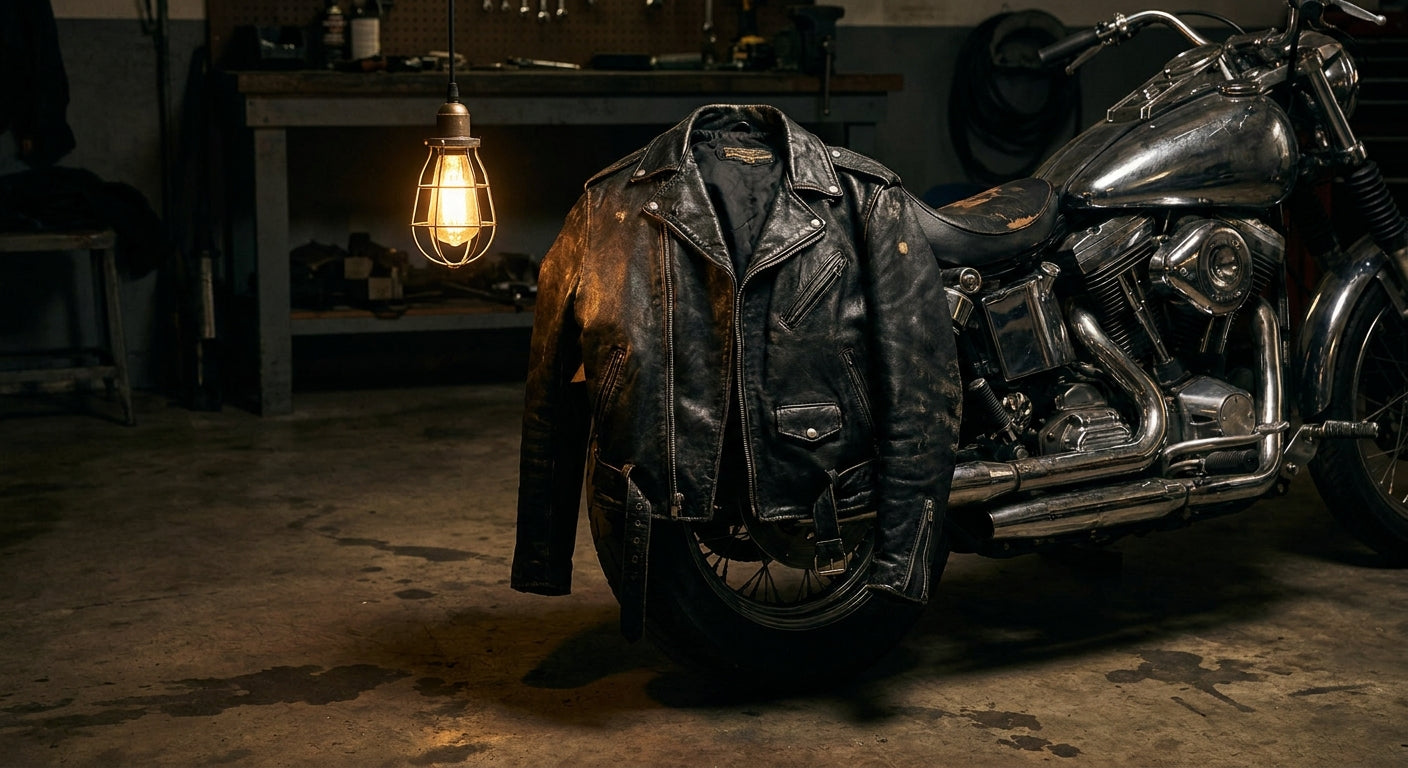
You're Not Buying a Jacket — You're Buying Armor
In 2024, 6,228 motorcyclists were killed on U.S. roads, accounting for 16% of all traffic fatalities. Upper body injuries to the shoulders, arms, and back appear in roughly 61% of non-fatal motorcycle crashes. Those numbers aren't abstract. They're the reason a fashion leather jacket and a purpose-built motorcycle jacket are fundamentally different products, not style variations.
This guide gives you a clear decision framework: leather grade, CE armor, thickness specs, jacket vs. vest, fit testing, and long-term care. No fluff. Just the information riders need to invest in gear that actually protects. The same standard of quality you bring to how you look should apply to every piece of gear you put on.
Leather Grade Is Everything — And 'Genuine Leather' Is a Warning Label
Most guys don't know this until it's too late: the phrase "genuine leather" stamped on a tag is not a quality endorsement. It's one of the lowest grade designations in the leather industry. It means the hide has been sanded, buffed, or split away from the strongest outer layer. What you're left with is a product that looks decent on a shelf but won't hold up when it matters.
Full-grain leather is the real deal. It retains the entire outer hide surface, which is the densest, most durable part of the skin. That surface hasn't been corrected or sanded down, so it keeps its natural strength and develops a rich patina over years of use rather than peeling apart after one season.
Cowhide remains the gold standard for abrasion resistance. It's thick, heavy, and proven. Buffalo leather is another strong contender; it's naturally denser because it stretches less during the tanning process, giving it a more rugged texture and substantial feel.
But the animal source alone doesn't determine durability. What actually matters is the combination of hide thickness, tanning method, and leather grade. Chrome tanning dominates the motorcycle gear market for good reason: it produces softer, more water-resistant, and more pliable leather compared to vegetable tanning. That flexibility matters when you're gripping handlebars for hours. Vegetable-tanned leather has its place (it ages beautifully), but chrome-tanned hides are the practical choice for riding gear.
Thickness Specs: What 1.0mm vs. 1.4mm Actually Means on the Road
Two jackets can look identical on a rack and perform radically differently in a crash. The difference comes down to leather thickness, a spec that's rarely listed prominently.
At 1.0mm, you're getting minimal protection. It's fashion-weight leather. The recommended range for genuine motorcycle use is 1.2–1.4mm, with 1.4mm and above considered professional or racing weight. Leather in this range offers abrasion resistance that lasts four to five times longer than textile gear during a slide. That's not a marginal improvement; it's the difference between road rash and intact skin.
Before you buy any leather jacket marketed as motorcycle gear, ask for or look up the thickness spec. If the seller can't tell you, that tells you something too.
CE Armor: The Spec Most Riders Skip (And Shouldn't)
A leather jacket without CE-rated armor is technically just a leather jacket. It doesn't matter how thick the hide is or how much you paid. The CE EN 13595 standard is what separates motorcycle gear from everything else. It measures three specific criteria: abrasion resistance, impact resistance, and burst strength.
Here's what proper armor placement looks like in a motorcycle jacket:
- Shoulder pockets: Required. Non-negotiable.
- Elbow pockets: Required. Non-negotiable.
- Back pocket: Strongly recommended, CE Level 1 at minimum.
- Chest pocket: Optional, but a smart addition for aggressive riding.
CE Level 1 armor provides solid baseline protection. CE Level 2 absorbs significantly more impact force and is worth the upgrade, especially for back and shoulder inserts. The price difference between Level 1 and Level 2 is small compared to the protection gap.
You'll also see impact ratings labeled AA, A, and B. AA is the highest protection rating available; B is the lowest. Most quality riding jackets should carry an A or AA rating. If a jacket doesn't list a CE rating at all, treat that as a red flag, not an oversight.
Riders know: the armor is the jacket. Everything else is just the shell that holds it in place.
Jacket vs. Vest: How to Make the Right Call
For most serious riders, this isn't an either/or question. It's a "when do I wear which" question.
The decision rule is straightforward. When temperatures drop below 60°F, or when you need full arm coverage and impact protection, a leather jacket is the right call. When it's warm, when you want to display patches, or when you need layering flexibility, a leather vest takes over.
Experienced riders often layer a vest over a jacket in cold weather. The vest handles patches and extra pocket storage while the jacket underneath provides insulation and arm protection. It's a functional system (though it looks sharp regardless).
Owning both isn't redundant. They serve distinct roles across seasons and riding conditions. The vest also carries real cultural weight. The club-cut silhouette has deep roots in greaser and classic biker heritage. Style and function aren't in conflict here; they never have been.
How to Fit-Test Gear in a Riding Position (Not a Mirror)
Most buyers try on jackets standing upright in front of a mirror. That's a mistake. A jacket that fits perfectly while standing can bunch at the waist, restrict shoulder movement, or expose your lower back the moment you're seated on a bike with your arms reaching forward.
Try on every jacket in a forward-reaching, seated position that simulates actual riding posture. Check that the back panel covers your lower back fully. Make sure the sleeves don't ride up past your wrists. Confirm that armor pockets stay aligned with your shoulders, elbows, and spine when your arms are extended, not shifting or gapping.
For vests, add 2–4 inches to your chest circumference measurement to determine the correct size. Then test it in that same forward-reaching position.
The Grease Shop's 30-day returns with free return shipping make this practical even when ordering online. Order your size, test it at home in riding position, and send it back if the fit isn't right. No risk, no hassle.
Care and Conditioning: Protecting a Multi-Decade Investment
A well-maintained full-grain leather jacket can outlast multiple bikes. That's not an exaggeration. But "well-maintained" means more than hanging it in a closet between rides.
Condition your leather every 3–6 months to prevent drying and cracking. After any wet ride, condition it as soon as the leather is dry. Skipping this step is how quality hides deteriorate prematurely.
For storage, aim for 60–70°F with approximately 50% relative humidity. Use a breathable garment bag. Never store leather in a plastic bag or in direct sunlight. Both trap moisture or cause fading and drying that shortens the jacket's life significantly.
Chrome-tanned leather is naturally more water-resistant, but it still benefits from regular conditioning. Vegetable-tanned leather requires more attentive care, especially after exposure to rain or humidity.
The care mindset fits the broader "built to last" approach riders are embracing right now. Substantial gear that develops character and patina over years is worth protecting. Cheap leather that cracks after one season was never worth buying in the first place.
Style That Earns Its Look: 2026 Trends Worth Knowing
The leading style directions in 2026 include cafe racer revivals in oxblood and matte grey, distressed patina retro racers, and hybrid fashion jackets incorporating sustainable bio-leathers. All of these silhouettes trace back to the same greaser and barbershop heritage that's been defining sharp style for over a century.
Irving Schott started making leather coats designed for motorcycle riders in 1913. That's more than a hundred years of functional heritage informing the jackets you see today. The best-looking jackets in 2026 are also the most substantive, because the riders buying them refuse to trade safety for style. Buy correctly spec'd gear and you don't have to make that trade.
Gear Up Right — Then Stay Sharp
Here's the framework in three lines:
- Buy full-grain leather at 1.2mm minimum thickness.
- Confirm CE-rated armor in the shoulders, elbows, and back.
- Choose jacket vs. vest based on temperature and riding context, and consider owning both.
Cheap, thin leather deteriorates after one season. Quality gear develops character and protects you for decades. That's not a marketing line; it's just how good leather works.
The same standard you bring to your grooming and personal style should apply to every piece of gear you ride in. Explore The Grease Shop's apparel and accessories catalog for gear that meets that sharp, no-compromise standard. Stay sharp out there.