
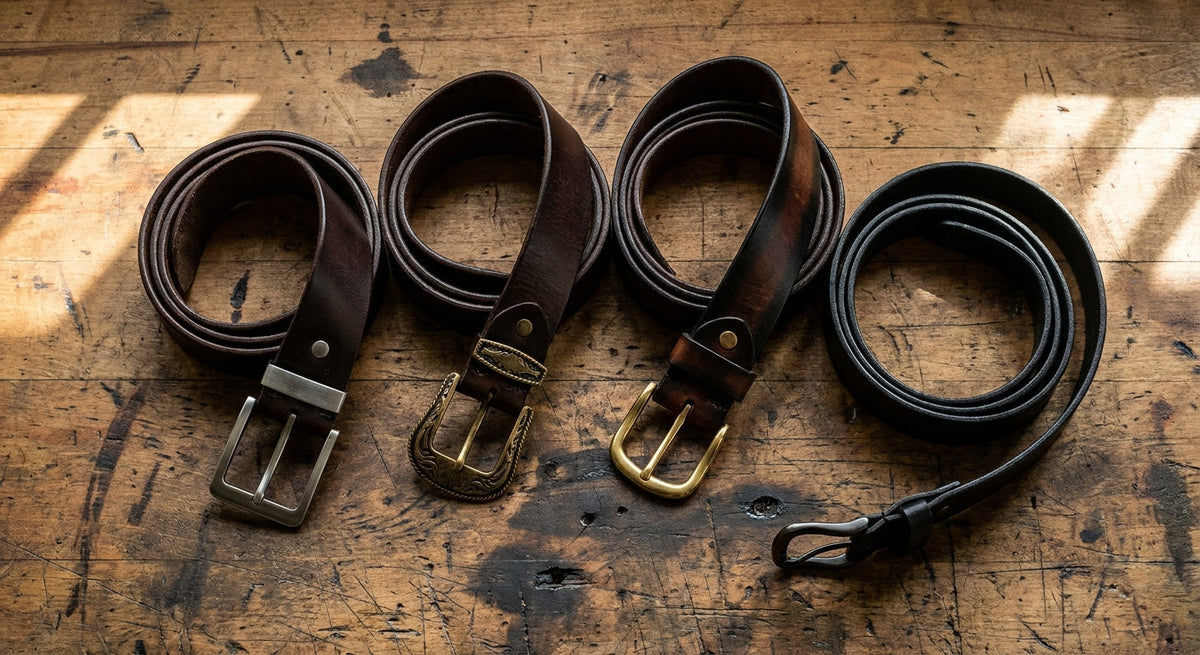
From Roman Scabbards to Biker Bars: Why Your Belt Buckle Says More Than You Think
Your belt buckle is the first thing people notice at waist level and the last thing most men think about when getting dressed. That's a missed opportunity.
Belt buckles trace back to the Bronze Age, where they held weapons and tools in place. Over 2,000 years ago, Roman soldiers refined the design to secure sword scabbards and horse-riding gear. Every buckle was functional, but it also communicated rank, readiness, and identity. That same energy carries forward today. The identity a Roman legionary put into his hardware isn't far removed from what a biker puts into a skull plate buckle on a Saturday night ride.
The global men's belts market hit $6.8 billion in 2025 and is projected to reach $11.2 billion by 2034. Men are clearly paying more attention to this accessory than ever. This guide breaks down how buckles work mechanically and what each style communicates culturally, so you can make a choice that actually fits who you are.
SEE OUR FULL COLLECTION OF BELTS & BUCKLES
The Four Buckle Mechanisms Every Man Should Know
Buckle types fall into two overlapping categories: how the mechanism works (functional) and what it communicates (cultural). A western trophy plate and a biker skull plate can share the exact same attachment system but send completely different messages. Understanding the mechanics first gives you the foundation to pick the right style.
Frame/Prong Buckle: The oldest and most common design still in use. A metal pin inserts into punched holes to secure fit. You'll find it on everything from formal dress belts to everyday leather. If you've worn a belt, you've probably worn this one.
Center Bar Buckle: Similar to the frame/prong, but without the surrounding frame border. The result is a cleaner, more minimal look that works well on casual and fashion-forward belts.
Plate/Snap-On Buckle: The standout for versatility. The buckle detaches from the strap entirely, letting you swap buckles on a single quality leather strap. A solid snap-on buckle can outlast multiple straps, making it a genuine long-term wardrobe investment. Compare that to a stitched-in fashion buckle, which shares the lifespan of the leather it's sewn into (typically 3 to 5 years with daily wear).
Box/Ratchet Buckle: No holes, no prongs. A micro-toothed track inside the strap provides stepless adjustment. These are popular in performance, work, and smart-casual contexts. Search interest in ratchet belts surged 99% month-over-month in early 2025, and the momentum hasn't slowed.
D-Ring Buckle: Two metal rings replace conventional holes for stepless adjustment. Common on canvas, webbing, and fabric belts, these suit casual and military-inspired looks.
Military/Tactical Quick-Release: A fully adjustable locking mechanism with no traditional hardware. Built entirely for function over form.
Men's Belt Style Categories: Matching the Strap to the Occasion
Think of men's belt styles in four practical categories: Formal, Casual, Work/Performance, and Specialty (western, biker, rockabilly). Each has its own rules for width, buckle type, and leather finish. Worth noting: wide belts (40mm / 1.5" and above) are making a strong comeback in 2026 after years of slim minimalism, crossing from runway collections into everyday men's smart-casual wear.
Formal Dress Belts
For suits and tailored trousers, stick with a slim 1" (25mm) width. Anything wider breaks the clean line of formal wear. The frame/prong buckle is the go-to here, and finish matters more than you might expect. A polished, shiny buckle signals formal and eye-catching. A brushed or matte finish reads as subtle and versatile, better suited for business casual.
The cardinal rule: match your leather color and finish to your dress shoes. High-shine black belt with black patent leather shoes. Tan belt with tan oxfords. No exceptions.
The dominant 2026 professional trend is the "quiet luxury" belt: full-grain leather, no logos, an aged natural finish, and a brushed metal buckle. Understated, but unmistakably quality. Reversible belts, which use a rotating clamp mechanism to flip between black and brown, are also a practical solution for professionals and travelers who want versatility without packing multiple belts.
Casual Everyday Belts
A width range of 1.25" to 1.5" works best for jeans, chinos, and business casual. Wide enough to fill belt loops without overwhelming the outfit. Center bar or plate buckles are common here, and antique or distressed finishes pair naturally with raw denim, boots, and vintage-inspired looks.
Leather remains the dominant material, but woven, canvas, and fabric belts with D-ring closures are strong options for warmer months or relaxed settings. Ratchet buckles are gaining ground in smart-casual wear too, thanks to their clean look and precise, hole-free fit.
Work & Performance Belts
Heavy-duty leather belts (thick, wide, reinforced) are built for tradesmen and active wear. The buckle needs to hold under physical stress, full stop. Tactical and ratchet systems dominate this category because there are no holes to wear out and no prongs to bend, just stepless adjustment for comfort during long shifts.
Buckle material matters for longevity, and this is a detail most belt guides skip entirely. Solid brass and nickel-plated metals outlast zinc alloy under daily stress. If you're putting a belt through real work, spend the extra few dollars on hardware that won't fail you.
Specialty Belts: Western, Biker & Rockabilly
This is where belt style becomes identity. Specialty belts are as much about subculture as they are about function. Three dominant styles define this space, each with its own distinct visual language. If we don't have what you want, let us know.
Patriotic Buckles
Men throughout the land of the free and the home of the brave show their love of country with a beautifully designed belt buckle. Designs include golden eagles, eagles embroidered in different colors, and ones that show state specific pride. Some have sayings such as "We the people" or the letters U.S.A.
Western & Rodeo Buckles
Western trophy buckles trace their roots to rodeo culture, where oversized plate buckles were awarded as prizes. Wearing one originally meant you'd earned it. Today they function as bold style statements in casual and semi-formal settings, and the western revival is one of the strongest belt trends of 2026, bridging mainstream fashion and biker/rockabilly subcultures.
Wide leather straps (1.5" to 2") are standard. Tooled leather detailing and antique or distressed finishes are authentic to the style. Pair with boots, raw denim, and chambray or flannel shirts for a complete look. The belt anchors the whole outfit.
Biker Buckles
Biker-culture buckle motifs carry specific meanings. Skulls represent rebellion and mortality. Eagles stand for strength and freedom. Flames signal energy and speed. Motorcycle engravings speak to identity and brotherhood. These aren't random decorations; they're chosen with intention.
These buckles are typically made from solid brass or nickel-plated metals, chosen for road durability, not just aesthetics. That's a quality signal worth understanding before you buy. Thick leather straps (1.5" wide, 5 to 6mm thick) are standard in biker style because the belt needs to match the weight and attitude of the buckle. Pair with leather jackets, work boots, and dark or raw denim. The belt is a load-bearing style element, not an afterthought.
Greaser & Rockabilly Belts: The Details That Make the Difference
In 1950s greaser culture, thin leather belts replaced suspenders as the dominant waist accessory. It was a practical shift that became a cultural uniform. One detail almost no mainstream belt guide mentions: mechanics of that era wore their belt buckle to the side to avoid scratching car paint while leaning over engines. What started as a practical shop habit became a recognized style marker.
Rockabilly and greaser looks today bring together chain wallets, leather belts, and western accessories paired with cuffed jeans, leather jackets, and work boots. The belt is the connective piece that ties the whole outfit together. The snap-on system on the Rumble59 strap means you can run a biker skull buckle on Monday and a western plate on Saturday. One strap, multiple identities.
Buckle Finish as Style Language: Polished, Brushed, or Antique?
Buckle finish is one of the most overlooked style decisions men make. It changes the entire register of the belt.
Polished/Shiny: Formal and eye-catching. Best for dress belts, patent leather shoes, and occasions where you want the hardware to stand out.
Brushed/Matte: Subtle and versatile. The workhorse finish for daily wear across business casual and smart-casual contexts. It aligns perfectly with the 2026 quiet luxury trend.
Antique/Distressed: Best for rugged or vintage-inspired styles: raw denim, work boots, biker leather, western looks. The Mascorro U.S. Flag Belt Buckle is a strong example of this finish done right.
Material quality matters just as much as finish. Solid brass is premium and durable. Nickel-plated is strong and road-ready. Zinc alloy is budget-tier and prone to wear. Knowing the difference helps you buy once and buy right.
Stay Sharp: How to Build a Belt Collection That Works Harder Than You Do
Think of belt ownership as a modular wardrobe strategy, not a one-and-done purchase. The core principle is straightforward: invest in one or two quality leather straps, then build a buckle collection over time. The snap-on plate system makes this practical and cost-effective.
Here's your quick-reference width guide by occasion:
- 1" (25mm): Formal suits and tailored trousers
- 1.25" to 1.5": Business casual and everyday wear
- 1.5" and wider: Casual, biker, and western looks
For formal settings, match leather finish to shoe finish. For casual and specialty, match belt weight to outfit weight. A thick biker strap looks wrong with slim chinos, and a thin dress belt disappears under a leather jacket.
Personalized engravings and reversible designs are key customization trends heading through 2026, worth considering if you want a belt that's distinctly yours.
The right belt isn't about vanity. It's about showing up put-together in every context you walk into: a job site, a bar, or a wedding. Stay sharp.